
April is Sexual Assault Awareness Month: Being Loud Enough to Change the Narrative
Content Warning
This post discusses sexual assault, violence, and trauma-related experiences, including physical violence and strangulation. It may be difficult for some readers.
Please take care of yourself while reading. You are encouraged to pause, skip sections, or step away if needed.
You are not alone. CNADA’s 24/7 crisis line is available by call or text.
______________________________________________________________________________________________________________________________________________________________________
April is Sexual Assault Awareness Month—a time to raise awareness, support survivors, and challenge the systems that too often fail them.
At CNADA, this month feels especially meaningful. Our team just returned from the End Violence Against Women International conference, where we learned alongside professionals from across the country about best practices in response, investigation, and survivor support. While there, we also watched the powerful documentary Loud Enough, Surviving Justice—a film that follows survivors as they navigate the criminal justice system and exposes the gaps, challenges, and barriers they often face when seeking accountability.
The film highlights something we see every day in our work:
survivors are often not failed by one moment—but by a system that was not built to fully support them.
It left us asking an important question:
Are we, as communities, loud enough when it comes to supporting survivors?
Understanding Consent: The Foundation of Everything
Consent is not complicated—but it is often misunderstood.
One of the simplest ways to understand consent comes from the well-known video Consent is Tea. (LINK TO WATCH: https://youtu.be/pZwvrxVavnQ)
It explains consent like offering someone a cup of tea:
If they say yes, you can give them tea
If they say no, you don’t give them tea
If they change their mind, you stop
If they’re unconscious, you don’t give them tea
Consent is:
Clear
Freely given
Ongoing
Reversible
Silence is not consent.
Fear is not consent.
Coercion is not consent.
If someone is intoxicated, unconscious, pressured, or afraid—they cannot legally or ethically give consent.
When we talk about sexual assault, we are talking about any sexual act that occurs without consent.
When Consent Changes: It Can Start Consensual and Still Become Assault
Something can begin consensual—and still become assault.
Consent must be ongoing. It can be withdrawn at any time.
If a situation escalates into:
Hitting or physical violence
Strangulation or choking
Threats or intimidation
…it is no longer consensual.
Even without saying “stop,” fear and harm remove consent.
What About When Someone Is Too Afraid to Say No?
This is where trauma responses come in.
Understanding Trauma Responses: Why Survivors React the Way They Do
Trauma responses are survival—not choice.
Fight – resisting
Flight – trying to escape
Freeze – unable to move or speak
Fawn – going along to stay safe
Many survivors freeze or comply.
That is not consent.
Why This Matters
From the outside, it can be misunderstood.
But:
Silence ≠ consent
Compliance ≠ consent
Lack of resistance ≠ consent
What Montana Law Recognizes
Montana law recognizes that fear and force remove consent.
Even if something started consensual, once fear or violence is introduced, it may meet the definition of sexual assault.
What Montana Law Says About Sexual Assault
Under Montana law:
Sexual Assault (§45-5-502): sexual contact without consent
Rape (§45-5-503): sexual intercourse without consent
Without Consent (§45-5-501) includes:
Force or threat
Intoxication or impairment
Unconsciousness
Coercion
Lack of resistance does NOT equal consent.
Note: This information is for educational purposes only and is not legal advice. If you have questions about your specific situation, we encourage you to speak with an attorney or an advocate.
What This Means in Real Life
If someone is afraid, being hurt, pressured, or unable to respond—consent is not present.
Even if something started consensual, it could become sexual assault the moment safety, choice, or control is taken away.
Sexual Assault in Montana: What the Data Tells Us
Sexual violence is happening right here in Montana.
According to the Montana Department of Justice and the Montana Coalition Against Domestic and Sexual Violence:
Montana ranks among the highest in the nation for sexual violence
Approximately 1,000–1,500 sexual offenses are reported each year
Many more incidents go unreported
But reporting is only part of the story.
Reports vs. Prosecution: What Happens After a Report
Even when survivors report, not every case moves forward in the justice system.
National data—reflected in trends seen across Montana—shows:
Out of every 1,000 sexual assaults, about 310 are reported to police
Around 50 lead to arrest
Approximately 28 lead to felony conviction
And about 25 result in incarceration
This means the majority of cases never result in prosecution or conviction.
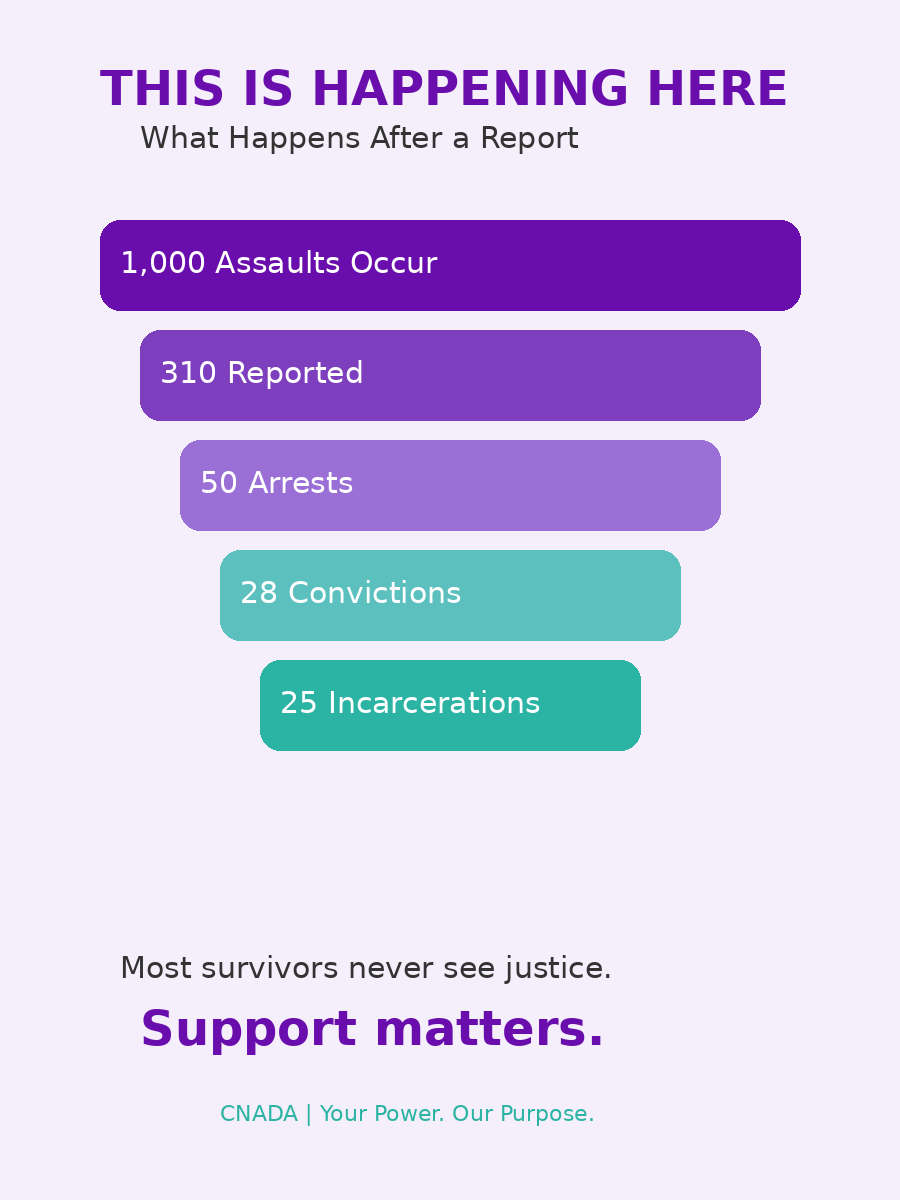
This graphic titled “This Is Happening Here: What Happens After a Report” illustrates the progression of sexual assault cases through the justice system.
It uses a funnel design with five horizontal bars that gradually narrow from top to bottom.
At the top, the widest bar reads “1,000 assaults occur.”
Below it, a slightly smaller bar reads “310 reported.”
The next bar reads “50 arrests.”
Below that, “28 convictions.”
At the bottom, the smallest bar reads “25 incarcerations.”
The narrowing shape visually represents how the number of cases decreases at each stage of the justice process.
At the bottom of the graphic, the text reads: “Most survivors never see justice. Support matters.”
The color scheme transitions from deep purple at the top to teal at the bottom.
What This Means for Survivors
For many survivors, the justice system can feel uncertain and overwhelming.
As highlighted in Loud Enough, Surviving Justice, survivors often face:
High burdens of proof
Delays and system gaps
Fear of not being believed
Trauma responses being misunderstood
Rural Montana: Unique Risks and Barriers
Sexual violence in rural communities comes with challenges that often go unseen—and deeply impact whether survivors are able to seek help, receive care, or pursue justice.
In eastern Montana and across the seven counties CNADA serves, survivors are not only navigating trauma—they are navigating distance, isolation, and limited resources.
Geographic Isolation
In rural Montana, help is often far away.
Survivors may need to travel:
Hours to reach a hospital with SANE services
Long distances to meet with law enforcement or attend court hearings
Across multiple counties just to access basic support
Transportation can become a barrier in itself—especially when someone does not have a reliable vehicle, gas money, or a safe way to leave.
Limited Access to Services
Many rural communities do not have:
Local advocacy organizations
24/7 medical care with trained SANE nurses
Mental health providers specializing in trauma
This means survivors may face delays in:
Medical exams
Evidence collection
Ongoing counseling and support
In some cases, survivors must choose between seeking care far from home or not seeking care at all.
Confidentiality Concerns in Small Communities
In small towns, privacy can feel impossible.
Survivors may worry:
“What if someone I know works at the hospital?”
“What if my report gets back to my family or community?”
“What if everyone finds out?”
When everyone knows everyone, seeking help can feel like risking exposure.
Knowing the Perpetrator
In rural areas, survivors are more likely to know the person who harmed them.
This can include:
A partner or ex-partner
A coworker
A neighbor
Someone connected through family or community
This adds layers of:
Fear
Complication
Pressure not to report
Especially when the person may still be part of daily life.
Fear of Not Being Believed or Supported
In close-knit communities, there can be strong social ties—and sometimes strong biases.
Survivors may fear:
Not being believed
Being blamed or questioned
Facing backlash from the perpetrator’s family or social circle
This fear can prevent survivors from coming forward at all.
Economic and Housing Barriers
Leaving a harmful situation in a rural area is not always simple.
Survivors may face:
Limited housing options
Financial dependence
Few available jobs
Long waitlists for assistance
Sometimes, staying feels like the only option.
System Gaps and Capacity Issues
Even when survivors reach out for help, systems can be stretched thin.
We are increasingly seeing:
Survivors in larger Montana cities being turned away from shelter due to capacity limits
Individuals reaching out across counties for services
Delays in response due to limited staffing and resources
In rural regions, there is often no backup agency—no overflow system—no second option.
Why This Matters
These barriers don’t just make things harder—they shape outcomes.
They affect:
Whether someone reports
Whether evidence is collected
Whether a case moves forward
Whether a survivor feels supported or alone
What CNADA Does
At CNADA, we work to bridge these gaps every day.
We:
Travel hundreds of miles to meet survivors where they are
Provide hospital and court accompaniment
Help coordinate transportation, housing, and basic needs
Offer support whether or not someone chooses to report
Because in rural Montana, access to support should not depend on your zip code.
In communities like ours, being “loud enough” means making sure no survivor has to navigate these barriers alone.
Why These Numbers Matter
These aren’t just statistics.
They are people in our communities.
This is happening here.
During Sexual Assault Awareness Month, we don’t just share numbers—we share truth. And the truth is, this is happening here—and the response must start here too.
Why Medical Care Matters: SANE Exams
After a sexual assault, survivors may choose to seek medical care. One option is a Sexual Assault Nurse Examiner (SANE) exam—a specialized exam designed to provide both medical care and, if the survivor chooses evidence collection.
It’s important to know:
You are in control of what happens during the exam.
What Happens During a SANE Exam?
A SANE exam is conducted by a nurse specially trained in trauma-informed care. The process is paced around the survivor’s comfort and consent.
The exam may include:
A conversation about what happened (only what the survivor wants to share)
This helps guide what care or evidence collection may be neededA physical exam
To check for injuries and ensure overall healthEvidence collection
This can include swabs, documentation of injuries, and clothing collection—but only with the survivor’s permissionPhotographs of injuries (optional and with consent)
Testing and prevention care, such as:
STI testing and prevention medication
Pregnancy prevention options
Treatment for any injuries
What Survivors Should Know
You can say yes or no to any part of the exam
You can stop the exam at any time
You can bring an advocate or support person with you
You can receive an exam without immediately reporting to law enforcement
The goal is not just evidence—it’s care, safety, and support.
Timing Matters—but Options Still Exist
Ideally, a SANE exam is completed within a certain timeframe (often within 72–120 hours depending on the situation), but:
Even if time has passed, medical care is still important and available.
Working with Law Enforcement
Reporting sexual assault is a deeply personal decision—and one that looks different for every survivor.
At CNADA, we support survivors whether they choose to report or not. There is no “right” choice—only what feels safest and most appropriate for that individual.
At the same time, understanding how the system works can help explain why law enforcement involvement plays a critical role when it comes to filing charges and moving a case forward.
How a Case Moves Forward
For a criminal case to be charged, it typically follows a process:
A report is made to law enforcement
An investigation is conducted
Evidence is gathered and documented
The case is reviewed by a prosecutor
A decision is made about whether charges can be filed
Without a report, there is usually no formal investigation, which makes it difficult for a case to move into the criminal justice system.
Why Law Enforcement Involvement Matters
Law enforcement plays a key role in building a case that can be reviewed for prosecution.
This can include:
Collecting statements
Documenting injuries and evidence
Interviewing witnesses
Gathering digital or physical evidence
Coordinating with medical providers and SANE nurses
This documentation helps establish:
What happened
Whether a crime occurred under Montana law
Whether there is enough evidence to meet the legal standard for charges
The Reality: Charging a Case Can Be Complex
Even when a report is made, not every case results in charges.
This can be due to:
Limited or delayed evidence
Lack of witnesses
Trauma responses being misunderstood
High legal standards (such as “beyond a reasonable doubt”)
This does not mean the assault didn’t happen—it means the system requires a specific level of proof to move forward.
Why Early Support Can Make a Difference
When survivors have support early on, it can help strengthen both their experience and, if they choose, their case.
This might include:
Receiving a SANE exam
Speaking with an advocate before or during reporting
Understanding what to expect from the process
Having someone present during interviews
Early support can help:
Preserve evidence
Reduce retraumatization
Improve communication with law enforcement
Increase the likelihood that a case is thoroughly documented
The Role of Advocacy
At CNADA, we help bridge the gap between survivors and systems.
We can:
Be present during law enforcement interviews
Help survivors understand their rights and options
Advocate for trauma-informed responses
Support survivors through each step of the process
Our role is not to pressure—but to empower survivors with information and support.
Balancing Truth and Choice
It’s important to hold both truths at the same time:
Law enforcement involvement is often necessary for charges to be filed
Survivors should never feel forced to report in order to receive support
Both can be true.
The Bottom Line
Reporting can open the door to accountability—but support should never depend on it.
Every survivor deserves:
To be believed
To be supported
To have choices
And when survivors do choose to engage with the system, they deserve to be met with respect, understanding, and trauma-informed care.
Being “loud enough” also means building systems that survivors can trust—so when they choose to come forward, they are supported every step of the way.
What We Saw in Loud Enough, Surviving Justice
While attending training with the End Violence Against Women International, we watched the documentary Loud Enough, Surviving Justice—and it’s something that stays with you.
The film follows survivors as they move through the criminal justice system, showing not just what happened to them—but what happens after they report.
It reveals a reality that many people don’t see:
The hardest part is often not just the assault—but navigating what comes next.
What the Documentary Shows
The documentary highlights how survivors can encounter barriers at every stage of the process:
Being questioned in ways that don’t account for trauma
Having their reactions misunderstood
Facing delays, gaps, or breakdowns in the system
Carrying the burden of proof in deeply personal and painful ways
It shows how trauma responses—like freezing or delayed reporting—are often misinterpreted, even though they are well-documented and common.
You can learn more about Loud Enough, Surviving Justice and watch the documentary here:
👉 https://www.loudenoughfilm.com
A System Not Always Built for Survivors
One of the most powerful takeaways from Loud Enough is this:
Our systems were not originally built with trauma in mind.
That can lead to:
Survivors feeling dismissed or doubted
Cases not moving forward
Individuals choosing not to report at all
Not because what happened wasn’t real—but because the process can feel overwhelming, confusing, or even re-traumatizing.
Why This Matters in Rural Montana
While the documentary shares stories from across the country, the themes are deeply familiar in rural communities like ours.
When resources are limited and systems are stretched:
Delays can be longer
Access to trained professionals can be harder
Survivors may feel even more isolated
This makes trauma-informed responses even more critical.
What Gives Us Hope
The documentary doesn’t just show what’s broken—it shows what’s possible.
When survivors are:
Believed
Supported
Met with trauma-informed care
…the experience can be different.
Outcomes can change.
Healing can begin.
Justice can feel more accessible.
How This Connects to Our Work
At CNADA, this is why our work matters.
We don’t just respond to crisis—we help navigate systems that can feel overwhelming.
We:
Stand beside survivors during interviews and court
Help explain what’s happening and what to expect
Advocate for trauma-informed approaches
Ensure survivors don’t have to go through the process alone
Because being “loud enough” isn’t just about awareness—it’s about changing how systems respond.
Being loud enough means more than speaking out—it means building systems that listen, understand, and respond in a way that truly supports survivors.
If You Need Support
You don’t have to go through this alone.
📞 24/7 Crisis Line (call or text): 406-951-0475
📞 Office:406-234-0542
🌐 www.cnada.org
We are here to listen, support, and walk alongside you—every step of the way.
Your Power. Our Purpose.